7 Solar Savings With EV Charging Facts That Pay Off
Last Updated: November 3, 2026
Quick Summary
Home solar charging can be 51% cheaper than grid electricity and 80% cheaper than public chargers, so solar savings with electric vehicle charging start the day your panels cover the miles you drive. Charging with solar runs roughly $415 a year, saving drivers more than $800 annually.
- Most homes need 4 to 8 extra panels to cover an EV, depending on annual miles and panel wattage.
- Charge between 10 a.m. and 3 p.m. to use the sun directly instead of pulling from the grid overnight.
- Net metering export credit rates are the single biggest swing factor in your solar savings.
- A 400-watt panel in decent sun makes roughly 500 to 600 kWh a year after real-world losses.
- ENERGY STAR certified chargers use 40% less energy in standby mode than non-certified models.
Table of Contents
- Why Solar Savings With Electric Vehicle Charging Add Up
- How Solar Panels Power an EV at Home
- Running the Solar Savings With Electric Vehicle Charging Calculator
- How Many Solar Panels to Charge an Electric Car
- When to Charge an EV With Solar for the Best Return
- Net Metering for Solar and EV Charging: What Changes Your Numbers
- Home Charging Equipment, Capacity, and Battery Storage Decisions
- Get Your Roof and Rate Plan Modeled Before You Sign
- Frequently Asked Questions
Why Solar Savings With Electric Vehicle Charging Add Up
Charging an electric car with home solar can cut your fuel costs by more than half compared with grid power. According to Anern Store's analysis of solar-integrated EV charging, home solar charging can be 51% cheaper than grid electricity and 80% cheaper than public chargers.
The math works because you are replacing two bills with one system. Solar savings start the day your panels cover the miles you drive.
Here is what most guides get wrong: they quote a single national average and stop.
- Home charging averages about $11.00 per full charge at the national rate of 18.34¢/kWh (Electric Choice's national charging cost analysis), and solar can beat that.
- Charging with solar runs roughly $415 a year, saving drivers more than $800 annually (Enphase's fuel cost comparison).
- Over 25 years, solar charging can save more than $14,000 versus grid energy (EnergySage's long-term analysis).
Below, we break down the panel count, the timing, and the rate rules that decide whether solar savings with electric vehicle charging pay off for your house.
Here are the headline cost figures the article cites for charging an EV with home solar versus grid power.
| Item | Value | Note |
|---|---|---|
| Solar vs grid charging | 51% cheaper | Home solar charging compared with grid electricity |
| Solar vs public chargers | 80% cheaper | Home solar charging compared with public chargers |
| Home charging cost | About $11.00 per full charge | At national rate of 18.34¢/kWh |
| Annual solar charging cost | Roughly $415 a year | Saves drivers more than $800 annually |
| 25-year savings | More than $14,000 | Solar charging versus grid energy |
How Solar Panels Power an EV at Home
Solar panels send direct current to an inverter, which converts it to the AC power your home and car charger use. When the sun is up, your panels feed the charger first.
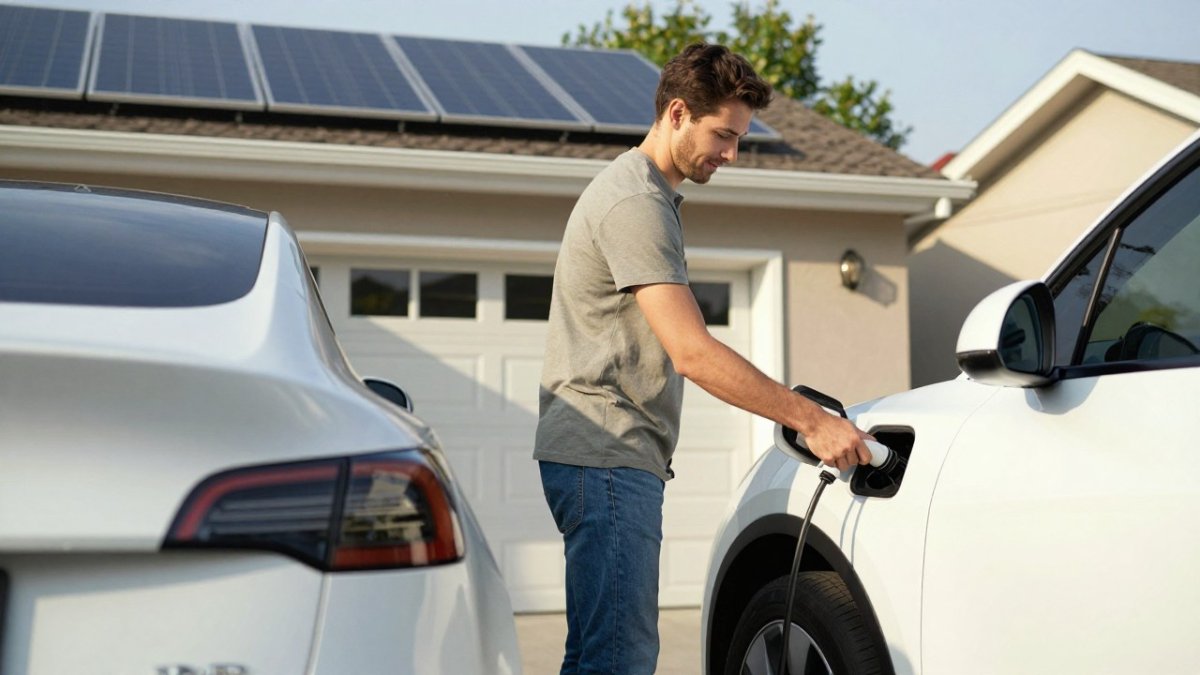
The car does not know or care where the electrons came from. What matters is the meter. If your panels produce more than your house and car use at that moment, you export the surplus.
That simple flow explains everything else . Panel count, charger size, and rate plan all change how much of your driving the sun actually covers. by 40% to 60% in most locations, according to MIT News research on EV emissions and cost savings.
Running the Solar Savings With Electric Vehicle Charging Calculator
A solar savings with electric vehicle charging calculator estimates your annual charging cost under solar versus grid power. Most calculators hide their assumptions. This one does not.
The output depends on six inputs: annual miles, vehicle efficiency, your electric rate, your solar production, system losses, and how your utility values exported power. Change any one and the answer moves.
Here is the step-by-step method:
- Miles per year. The average driver covers about 13,500 miles. Use your own odometer or commute math, not the average, if you drive more or less.
- Efficiency. Most EVs use 0.25 to 0.35 kWh per mile. A efficient sedan sits near 0.25; a larger SUV or truck sits near 0.35. Use the EPA fuel-economy label for your model, which lists kWh per 100 miles; divide by 100 to get kWh per mile.
- Annual EV energy. Multiply miles by efficiency. At 13,500 miles and 0.30 kWh per mile, that is 4,050 kWh per year.
- Grid cost. Multiply annual EV energy by your all-in electric rate. At 18.34¢/kWh, 4,050 kWh costs about $743 per year. Add any fixed charges or demand fees your utility applies.
- Solar production. A 400-watt panel in decent sun makes roughly 500 to 600 kWh a year after real-world losses. A 6 kW system in a moderately sunny climate commonly produces 7,500 to 9,000 kWh per year. Use your installer's production estimate, not a nameplate rating.
- System losses. Inverters, wiring, soiling, and temperature cut production by roughly 14% to 20% from the panel's rated output. Most modeling tools apply a default loss factor near 14%; ask what yours uses.
- Solar cost for the EV share. If your system produces 8,000 kWh and your EV needs 4,050 kWh, the EV's share is about half your production. Multiply your levelized solar cost per kWh by 4,050. Installed cost per watt and the resulting cost per kWh depend on your system size, sun exposure, and financing. Request a quote for figures specific to your roof.
- Export credit. If you charge at night, the solar power you send to the grid is credited at your utility's export rate, not at the retail rate. Multiply exported kWh by that credit. If the credit is lower than retail, your effective solar cost for nighttime charging rises.
- Compare. Subtract the solar cost plus any export-credit shortfall from the grid cost. The gap is your annual savings.
One real example: a SolarReviews case study found annual fuel costs dropped to $219 for 13,500 miles of driving on a residential solar system (Namaste Solar case study).
You can see how a $0-down solar lease works and run these numbers against your own roof.
How Many Solar Panels to Charge an Electric Car
Most homes need 4 to 8 extra panels to cover an EV, on top of what the house already uses. The exact number comes down to your annual miles and your panel wattage.
Work it out in three steps:
- Annual EV energy: 13,500 miles × 0.3 kWh per mile = 4,050 kWh.
- Panel output: a 400-watt panel in decent sun makes roughly 500 to 600 kWh a year.
- Divide: 4,050 ÷ 550 ≈ 7 to 8 panels.
Drive less and you need fewer. A short commute of 7,000 miles needs about 4 panels. A long commute or a second EV pushes you toward 10 or more.
Panel count is only half the answer. System size, roof angle, and shade all move the result. A west-facing roof with afternoon tree shade will need more panels than a clear south-facing one.
When to Charge an EV With Solar for the Best Return
Charge your EV during peak solar production, usually 10 a.m. to 3 p.m., to use the sun directly.
Timing is where most homeowners leave money on the table. Two habits help:
- Set a charge schedule. Most cars let you delay charging to a set window. Line that window up with your sunniest hours.
- Use solar-surplus controls. Smart chargers can ramp up when your panels produce more than the house needs.
If you work from home or can plug in on weekends, daytime charging is easy.
Watch out: charging at night on a flat rate means your EV runs on grid power, and your solar savings shrink to whatever your net metering credits are worth.
Net Metering for Solar and EV Charging: What Changes Your Numbers
Net metering is the rule that sets how much credit you get for power your panels export to the grid.
Maryland and Virginia run different programs, with different credit rates and carryover rules. You can compare Maryland and Virginia net metering laws side by side before you size a system.
A few things to check in your tariff:
- The credit rate for exported power. Some utilities credit exports at the full retail rate; others credit at a lower avoided-cost rate or a wholesale rate.
- Whether credits carry month to month or reset. Annual true-ups can wipe out credits you banked in spring if you do not use them by the reset date.
- Any cap on system size. Many programs limit the system to a percentage of your historical usage, which can block sizing for an EV you have not bought yet.
- Time-of-use windows and their rates. If your utility charges more from 4 p.m. to 9 p.m. and less overnight, the value of charging shifts by the hour.
That last point is where most homeowners leave money on the table.
A simple rule of thumb: compare your export credit per kWh with your overnight off-peak rate per kWh, then decide which approach your numbers favor.
Federal help exists too. Tax credits allow up to 30% savings on the cost of buying and installing EV charging infrastructure, per the Alternative Fuels Data Center.
Rising electric rates make this matter more. Our guide on how electricity rate increases affect solar payback models how escalation changes your long-term return.
Home Charging Equipment, Capacity, and Battery Storage Decisions
A Level 2 home charger adds considerably more range per hour than a standard outlet, which is why it is the usual choice for overnight home charging.
Before you buy, check three things:
- Electrical capacity. Your panel may need an upgrade to carry a 240-volt circuit.
- Charger efficiency. ENERGY STAR certified chargers use 40% less energy in standby mode than non-certified models (ENERGY STAR EV charger standards).
- Battery or no battery. A battery stores daytime surplus for nighttime charging. Without one, you rely on net metering credits.
Battery storage versus direct daytime charging is the real decision. A battery lets you charge at night on your own power.
For homeowners weighing this, our breakdown of Maryland solar battery storage options covers sizing, cost, and incentives.
Get Your Roof and Rate Plan Modeled Before You Sign
Solar savings with electric vehicle charging are real, but they are not one-size-fits-all. The financial benefit depends on your utility rates, your net metering policy, and how much you actually drive.
That is the gap Go Solar DMV closes.
If you are ready to model your own roof and rate plan, our step-by-step Virginia solar savings guide walks you through payback, lifetime savings, and ROI using real electricity rates.
Frequently Asked Questions
Is solar worth it if you have an EV?
For most homeowners who drive regularly, pairing solar with an EV improves the payback. Solar charging can reduce what you pay for fuel compared with grid power and public chargers, and the amount depends on your situation. The math depends on your utility rate, net metering policy, and how much you drive, so model your own numbers before signing.
How many solar panels do I need to charge an electric car?
Start with your annual miles and your EV's efficiency. A driver covering 13,500 miles in a vehicle that uses about 0.3 kWh per mile needs roughly 4,000 kWh per year. The exact array size depends on your roof and local sun exposure. Add panels for your household load. A solar savings with electric vehicle charging calculator built on your ZIP code and roof orientation gives a tighter estimate than a national average.
Can I charge my EV with solar panels without a home battery?
Yes. Most solar-plus-EV households charge directly from solar production during daylight hours and pull from the grid at night. A battery lets you store excess solar generation and shift it to evening charging, but it adds cost and is not required for the pairing to work. If your utility offers net metering, exported solar credits can offset nighttime charging without any battery at all. Check your specific tariff, because export compensation rates vary widely by state and utility.
How do net metering rules affect solar savings from EV charging?
Net metering decides what happens to solar you export instead of using on site. Under 1:1 net metering, each exported kilowatt-hour credits your bill at the full retail rate, so nighttime EV charging offsets almost dollar for dollar. Lower export rates or avoided-cost compensation shrink that value and make daytime charging and battery storage more attractive. Rules differ between Virginia, Maryland, and Washington D.C., and they change. Confirm your utility's current tariff before you size a system around EV load.
Your electric bill is not going down on its own, and every month you wait is a month of savings you do not get back. Go Solar DMV helps you lock in an affordable rate for up to 25 years, with a system installed and maintained at no cost. Get started with Go Solar DMV and see what your roof can actually save you.
