Maryland vs Virginia Net Metering Laws: Key Differences
Last Updated: October 23, 2026
Quick Summary
Maryland and Virginia net metering laws differ significantly in system sizing, compensation, and costs. Maryland allows systems up to 200% of annual consumption with 1-for-1 retail-rate credits and minimal standby charges, while Virginia caps systems at 100% of consumption, imposes monthly distribution and transmission standby charges of $2.79/kW and $1.40/kW respectively, and includes stricter interconnection requirements.
- Maryland's Utility RELIEF Act doubled program capacity from 3 GW to 6 GW and expanded net metering opportunities.
- Virginia limits residential systems to 20 kW for Dominion Energy customers and generally requires sizing at or below 100% of annual consumption.
- Virginia standby charges on a 7 kW system total roughly $350 annually, significantly reducing net metering value despite 1-for-1 retail-rate credits.
- Maryland interconnection typically takes 30-60 days for residential systems under 10 kW, while Virginia timelines commonly run 30-90 days.
- Virginia's State Corporation Commission rejected Dominion Energy's proposed 30-minute netting interval in 2025, preserving the current hourly structure.
Table of Contents
- How Net Metering Works in Both States
- Maryland Net Metering Rules and Eligibility
- Virginia Net Metering Rules and Eligibility
- Maryland Solar Interconnection Requirements and Process
- Virginia Solar Net Metering Credits and Compensation
- Side-by-Side Comparison: What Changes Your Bottom Line
- Why These Differences Matter for Your Solar Decision
- Frequently Asked Questions
How Net Metering Works in Both States
Net metering credits solar customers for excess electricity sent back to the grid. When your system generates more power than you're using, the surplus flows to neighboring homes and your meter runs backward, offsetting consumption when the sun isn't shining. This lets homeowners use solar without battery storage while maintaining grid reliability.
The core principle is simple: you're paid for exports at the same rate you pay for imports. But Maryland vs Virginia net metering laws diverge significantly, with different capacity limits, compensation structures, and utility approval processes. Understanding these differences is critical before you invest, because they directly affect your long-term savings.
At Go Solar DMV, we help homeowners navigate these state-specific rules using tools like Google Project Sunroof 3D irradiance modeling to predict system performance under each state's net metering framework. The difference between a well-designed system under Maryland versus Virginia rules can shift your payback timeline by years.
Both states recognize solar as essential to their renewable energy goals, but chose different policy paths. Maryland allows larger systems and more aggressive sizing. Virginia emphasizes system-to-load matching and includes standby charges that reduce net metering value. These aren't minor details, they're foundational to how much you'll actually save.
Maryland Net Metering Rules and Eligibility
Maryland's net metering program is one of the most generous in the region. Eligible systems can be sized up to 200% of annual electricity consumption, letting you install a significantly larger system than typical usage requires, a major advantage for homeowners planning future electrification or with seasonal usage patterns.
Under Maryland law, residential and commercial customers can participate in net metering if their renewable energy systems meet state requirements. Maryland's net-metering framework provides 1-for-1 credit for exported electricity, meaning every kilowatt-hour you send to the grid earns a credit equal to the retail rate you'd otherwise pay. This is retail-rate net metering at its most straightforward.
The Maryland Public Service Commission recently approved changes under the Utility RELIEF Act. The program capacity was doubled from 3 GW to 6 GW, and the commission is designing a new net-metering program framework. These changes expand opportunity for new solar customers while the transition occurs. Annual true-up happens once per year, meaning any excess credits roll over month-to-month and are reconciled annually. Unused credits at year-end may be forfeited or carried forward depending on your utility's specific tariff.
Maryland homeowners should verify their utility's interconnection timeline and any standby charges, since individual utilities administer the program with slight variations. Go Solar DMV's Master ZIP code index identifies your utility and pulls the exact tariff rules for your system size and location.
Virginia Net Metering Rules and Eligibility
Virginia's approach to net metering is more restrictive than Maryland's, reflecting a different policy philosophy around solar integration. Virginia Code § 56-594 establishes the state's net-metering framework, effective January 1, 2027. Eligible customers participate under a Commission-established program, but the rules are tighter on system sizing and compensation.
Virginia generally requires systems to stay at or below 100% of annual electricity consumption, with limited exceptions. For Dominion Energy customers, the residential net-metering cap is 20 kW, per the 2026 program summary, substantially smaller than Maryland's allowance, reflecting Virginia's emphasis on "behind-the-meter" generation sized to match actual load rather than maximize export.
Compensation in Virginia follows a 1-for-1 retail-rate model similar to Maryland's, but standby charges reduce the practical value. Many Virginia utilities impose monthly distribution and transmission standby charges on net-metering customers, ranging from several dollars to $15-30 monthly depending on utility and system size. Factor these into your savings calculation.
Virginia's regulatory environment is actively debated. In 2025, Dominion Energy and Appalachian Power sought changes to net-metering rules. The Virginia State Corporation Commission rejected Dominion's proposed 30-minute netting interval, preserving the existing hourly netting structure. This decision maintained the current compensation model, but ongoing policy discussions mean Virginia rules could shift. Homeowners considering solar in Virginia should lock in interconnection agreements soon if they want to secure current terms.
Maryland Solar Interconnection Requirements and Process
Maryland's interconnection process is administered utility by utility under standards adopted by the Maryland Public Service Commission.
The application package typically includes a completed utility interconnection form, a one-line electrical diagram, inverter and module specification sheets, proof of property ownership or tenant authorization, and evidence of local electrical permit.
A key procedural advantage in Maryland is that net-metering applications are generally submitted alongside the interconnection request, so the two reviews proceed in parallel. Once the utility approves and local inspection is complete, it issues PTO and installs or reconfigures a bidirectional meter recording both imports and exports, the basis for every net-metering credit on your bill.
Maryland also sets review timelines that protect customers from indefinite delay: if a utility doesn't respond within the specified period, the application can move forward. The most common causes of delay are incomplete electrical drawings, missing proof of authorization for tenants or HOA properties, and equipment not yet on the utility's approved inverter list.
Utility variation matters. Baltimore Gas and Electric, Pepco, Delmarva Power, Potomac Edison, and Southern Maryland Electric Cooperative each publish their own interconnection manuals and portals, with differing document requirements and review queues. A cooperative territory may follow a different timeline than an investor-owned utility even though the state net-metering statute is the same.
Go Solar DMV's quote comparison audit includes an assessment of interconnection timelines for your specific utility, so you know exactly how long approval is likely to take before you commit to a solar partner.
Virginia Solar Net Metering Credits and Compensation
Virginia's net-metering credit structure looks simple on paper, exports are credited at the full retail rate one-for-one, but the practical value depends on three easy-to-miss mechanics: the netting interval, the annual true-up, and standby charges.
Netting interval. Virginia utilities net imports and exports over a defined interval rather than instantaneously. The Virginia State Corporation Commission preserved the existing hourly netting structure, rejecting a 30-minute interval.
Credit rollover and annual true-up. Excess electricity exported during high-production hours is credited at the retail rate, and surplus credits roll forward month to month. At the end of the 12-month true-up period, remaining credits follow your utility's tariff, typically forfeited or paid at an avoided-cost rate well below retail.
Standby charges. This is where Virginia diverges most from Maryland. Many Virginia utilities impose monthly distribution and transmission standby charges on net-metering customers.
A worked example. Consider a Virginia household with a 7 kW system that imports 900 kWh in a month and exports 600 kWh.
Why sizing is conservative. Because Virginia generally limits systems to 100% of annual consumption and applies standby charges per kW, larger systems carry higher fixed monthly costs and greater risk that year-end credits are forfeited or paid at avoided cost.
Virginia's one-for-one credit rate looks attractive until you subtract standby charges and account for year-end true-up. That's why a careful bill-credit model, not simple retail-rate multiplication, is the right way to compare Virginia net metering against Maryland's.
Side-by-Side Comparison: What Changes Your Bottom Line
| Factor | Maryland | Virginia |
|---|---|---|
| Max System Size | Up to 200% of annual consumption | Up to 100% of annual consumption |
| Residential Capacity Cap (Dominion) | N/A | 20 kW |
| Credit Rate | 1-for-1 retail rate | 1-for-1 retail rate |
| Monthly Standby Charges | Typically none | $2.79/kW distribution + $1.40/kW transmission |
| Annual True-Up | Month-to-month rollover | Month-to-month rollover, year-end reconciliation |
| Interconnection Timeline | 30-60 days typical | 30-90 days typical |
| Policy Stability | Recent expansion (Utility RELIEF Act) | Active debate; SCC rejected proposed changes in 2025 |
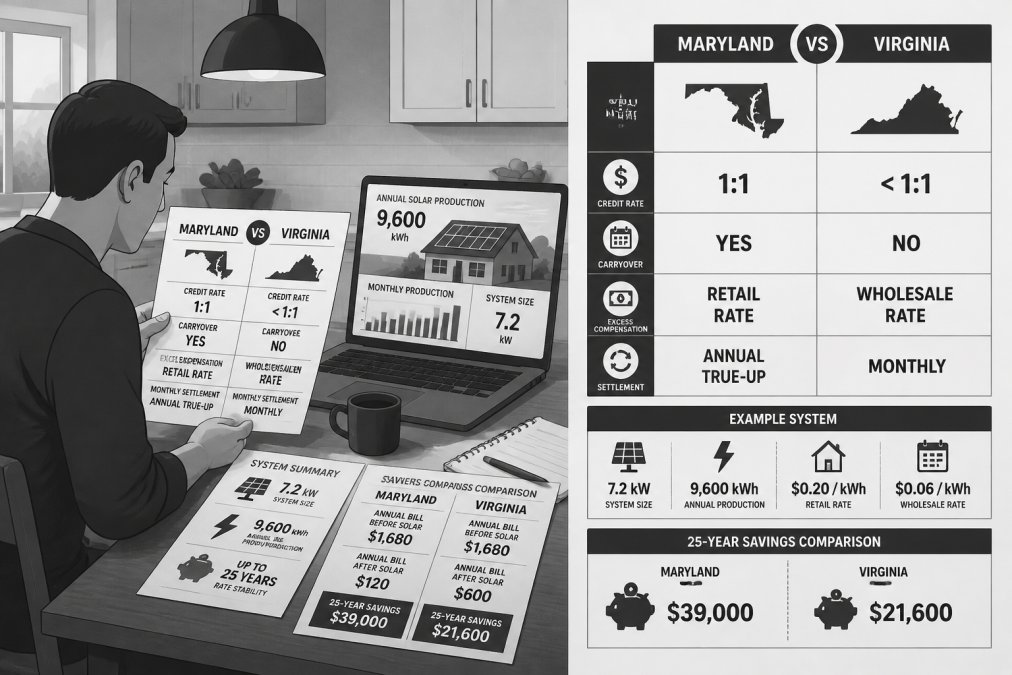
The practical impact is significant. A 7 kW system in Maryland might generate $1,200 in annual net metering credits with minimal standby charges. The same system in Virginia could generate $1,200 in credits but face $400-500 in annual standby charges, netting $700-800 in real benefit.
Maryland's higher capacity allowance lets you size more aggressively for a future electric vehicle or heat pump. Virginia's stricter limits force a choice: optimize for today's consumption or anticipate future electrification with a smaller system now. Go Solar DMV's AI Solar Advisor models both scenarios under each state's rules, showing the long-term impact of today's sizing decisions.
Why These Differences Matter for Your Solar Decision
The Maryland vs Virginia net metering laws difference isn't academic, it determines whether solar makes financial sense for your situation. A homeowner with high summer air conditioning loads and moderate winter heating might thrive under Maryland's generous export model.
Policy stability also matters. Maryland recently expanded its program and committed to redesigning net metering to remain competitive. Virginia's regulatory environment is in flux: Dominion Energy and Appalachian Power have proposed changes that could further reduce net metering value, though the State Corporation Commission has rejected the most aggressive proposals so far.
The interconnection and approval process differs too. Maryland's clear timelines and simplified applications mean faster deployment. Virginia's process is longer and more variable by utility. If you need solar operational quickly, perhaps to offset a rate increase, Maryland's faster timeline is an advantage.
For Go Solar DMV clients, these state-level differences drive our recommendation process.
The choice between Maryland and Virginia solar isn't just about system size or credit rates, it's about which state's regulatory framework aligns with your financial goals and timeline. Get started with Go Solar DMV and understand exactly how net metering laws in your state affect your solar savings.
Frequently Asked Questions
What is the main difference between Maryland and Virginia net metering rules?
Maryland allows residential systems sized up to 200% of annual electricity consumption and offers 1-for-1 net metering credits at the retail electricity rate. Virginia limits residential systems to 20 kW for Dominion Energy customers. Virginia's compensation structure and credit rollover rules vary by utility. These differences directly affect how much you save over time and what system size fits your property.
Do net metering credits roll over month to month in both states?
Maryland offers monthly credit rollover, meaning unused credits carry forward to offset future bills. Virginia's credit rollover varies by utility. Some Virginia utilities complete an annual true-up. Check your specific utility's tariff to confirm whether excess generation credits roll over or reset. This affects whether you need to size your system conservatively or can install a larger system.
What are the Maryland solar interconnection requirements I need to know before applying?
Maryland requires utility approval and interconnection before your system exports electricity to the grid. You must submit an interconnection application to your utility, which reviews your system design, electrical safety, and grid impact. The approval timeline varies by utility but typically takes 30-60 days. Utilities may require equipment upgrades or specific safety measures. Working with a solar installer familiar with Maryland's interconnection process speeds approval and reduces delays.
How do Virginia solar net metering credits get applied to my bill?
Virginia solar net metering credits appear on your monthly electric bill as a credit against electricity charges. When your system generates more than you use, the excess flows to the grid and reduces your bill dollar-for-dollar at the retail rate. The exact mechanism depends on your utility and metering equipment (bidirectional meter). Some utilities settle credits monthly; others conduct an annual true-up. Standby charges or other fees may also apply, so review your utility's specific tariff.
